

Image © European Central Bank.
GBP/EUR has risen back into the middle of the 2026 range, where it tends to look most comfortable.
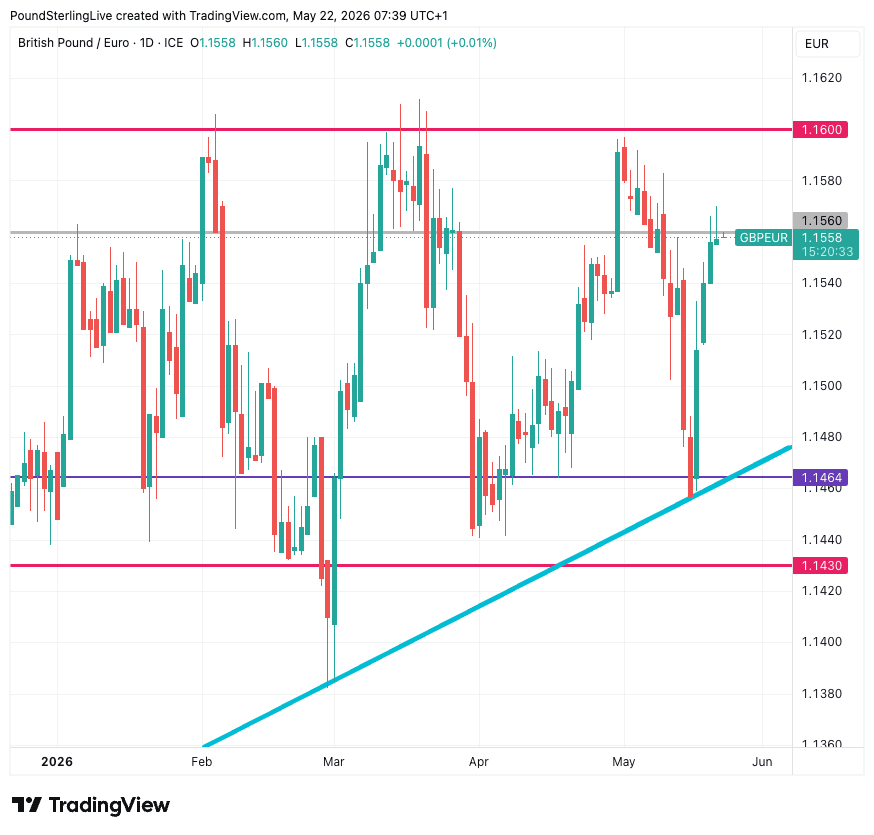
But with short-term technical indicators still pointing higher, further gains are still possible, even if experience gleened from the past year's worth of trading suggests upside prospects become increasingly limited once levels at 1.1560 are reached.
This is rarefied air: 1.1560 is a notable resistance line that guards the ascent to the 1.16 peak; it's where sellers start emerging. Price action from the past three days shows that two attempts to close above 1.1560 failed, and if Friday's close is below the line, then the odds of a pullback towards 1.15 next week will begin to grow.
Risk-reward suggests locking in a portion of the international transfer budget at current rates is prudent.
If the pair can end the week above 1.1560 an attempt at 1.16 is on the cards for the coming days, however there are numerous orders placed ahead of 1.16 that could arrest the advance before that big round number is tested.
On May 01 the short-term uptrend stalled at 1.1597 and then reversed; those with payment requirements that are targetting this high level should consider engaging a payment specialist to set an order to ensure they don't miss out.
Previously he said the government shouldn't be "in hoc" to bond markets, that fiscal rules should be bent to fund social housing and defence.
However, Monday saw Burnham u-turn and confirm he won't fiddle with the rules, ensuring some political risk premium that was weighing on pound sterling evaporates.
"The pound has backtracked from this month’s weakest levels vs. both the EUR and the GBP in part due to assurances from potential Labour leadership contender Burnham regarding the current Chancellor’s fiscal rules. We see scope for further choppy range trading," says Jane Foley, Senior FX Strategist at Rabobank.
But there's more to the story: oil prices are coming down as hopes build that the war in the Middle East will end.
That's bringing UK bond yields - i.e. government borrowing costs - lower and that's taking some stress out of the system.
Lower oil prices can't come soon enough: May's PMI data released Thursday showed Britain's private sector economy suffered a notable slowdown in May as political and geopolitical pressures mounted.
That would normally entice the Bank of England into lowering interest rates. However, the headline from the PMI data is that inflationary pressures are building, leaving the Bank with little choice but to hold interest rates.
That guarantees the UK's interest rate advantage over the Eurozone will endure, and for GBP/EUR, that's supportive.