

Image © Adobe Images
GBP/NZD could soon break out of its short-term consolidative spell.
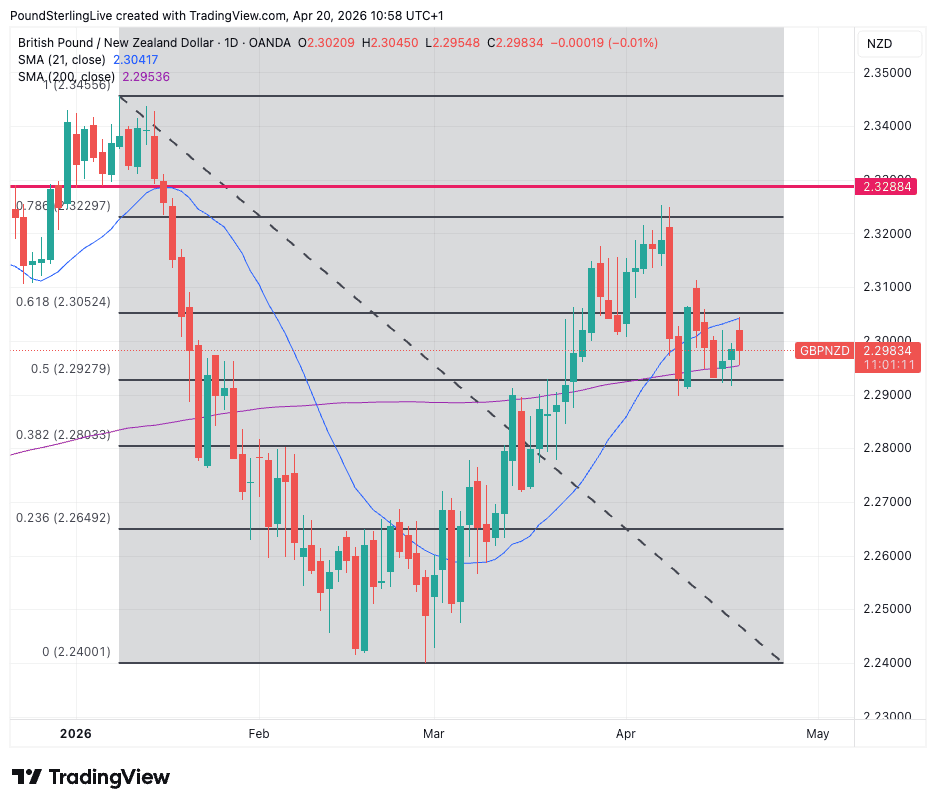
The pound-New Zealand dollar exchange rate is flat at the time of writing at 2.2975 as it consolidates between the 21-day and 200-day moving averages (at 2.3040 and 2.2953, respectively).
Support at the 200-day MA protected the pair from any meaningful decline on Monday and there's an additional layer of support at 2.2927, which is the 50% Fibonacci retracement of the January-February decline. The level has underpinned GBP/NZD for the past two weeks.
The daily chart tells us quite clearly that we're in a wait-and-see period for GBP/NZD and that a breakout will eventually follow: either lower in sympathy with the broader multi-week consolidation sequence or higher, in sympathy with the post-February rebound.
So we won't pretend to know which way the market is going, but we can give readers an idea of the levels to target in either direction:
To the downside, targets are set at 2.2649 (1-2 weeks) and then 2.24 (3-4 weeks), which is the 2026 low.
To the upside is 2.3229 (the 78.6% Fib retracement, 1-2 weeks) and then 2.34 (3-5 weeks), which is the approach to the multi-year top.
The fundamental trigger will be the Iran war, where the U.S. and Iran must agree to an extension of the 2-week ceasefire, which runs out tomorrow.
Failure to do so would likely undermine the New Zealand dollar, which has been one of the war period's biggest currency underperformers. (New Zealand's lack of domestic refining ability and reliance on Asian refiners, all of which source most of their oil from the Middle East, is to blame.)
Monday's headlines aren't very helpful in this regard as Iran and the U.S. square up ahead of another round of negotiations.
With this in mind, we think the downside risks to NZD are limited as a resolution to the war will be found.
Current tensions are likely a negotiating ploy ahead of talks, meaning it's costly for traders to be over-reactive and too pessimistic on the headlines.
NZD's resilience this Monday confirms traders are still optimistic that the coming weeks will deliver a real resolution to the crisis.